ASX: AMD
0.0240
-7.69%

ASX: AMD
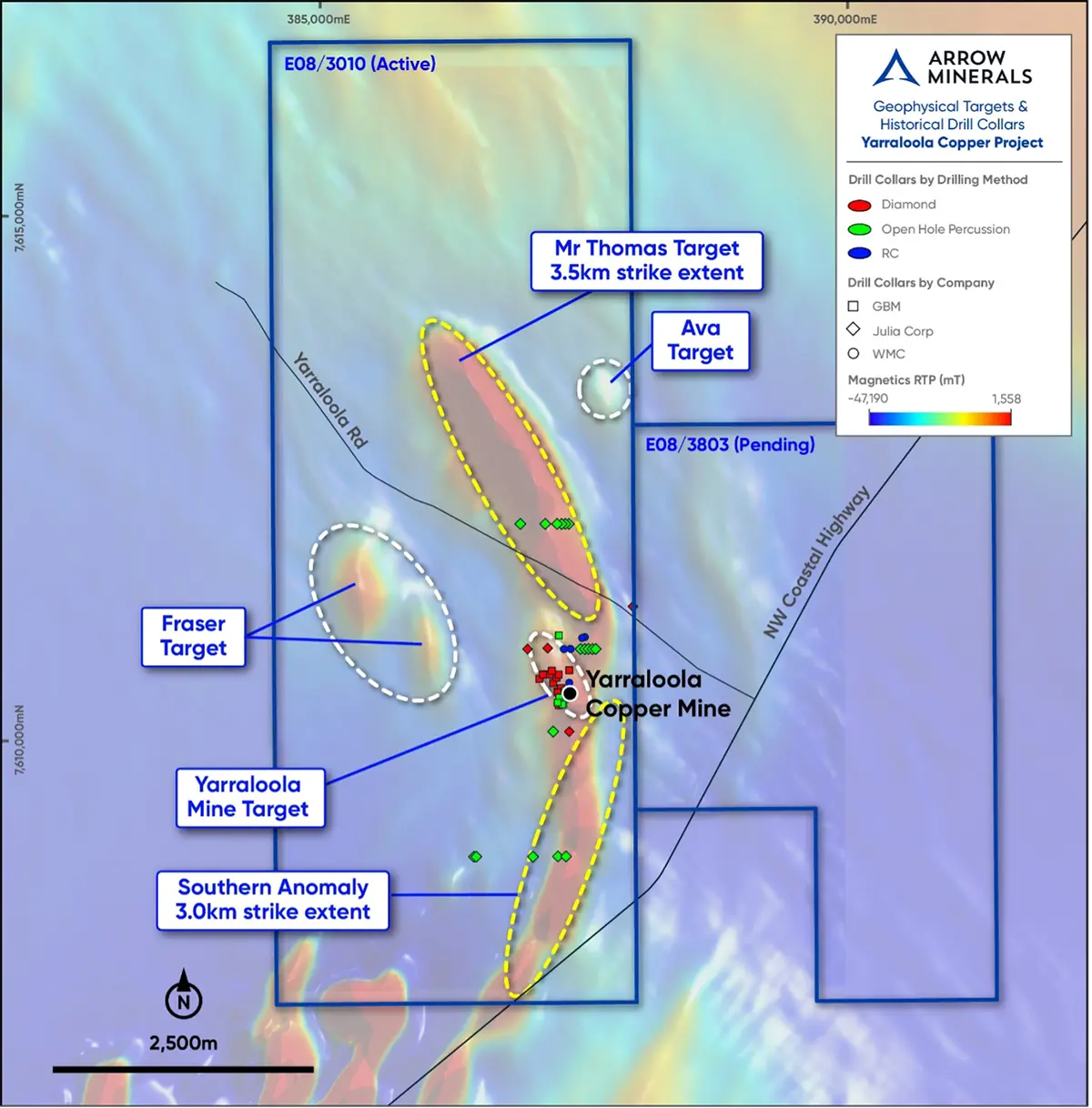
Yarraloola features historical copper mine workings that have been partially tested in historical drilling, complemented by recently identified gold in rock chips at surface. When combined with excellent additional targets identified by one of the state’s leading geophysics groups, and the lack of modern systematic exploration for 50 years, the Company considers Yarraloola to be a very attractive project.
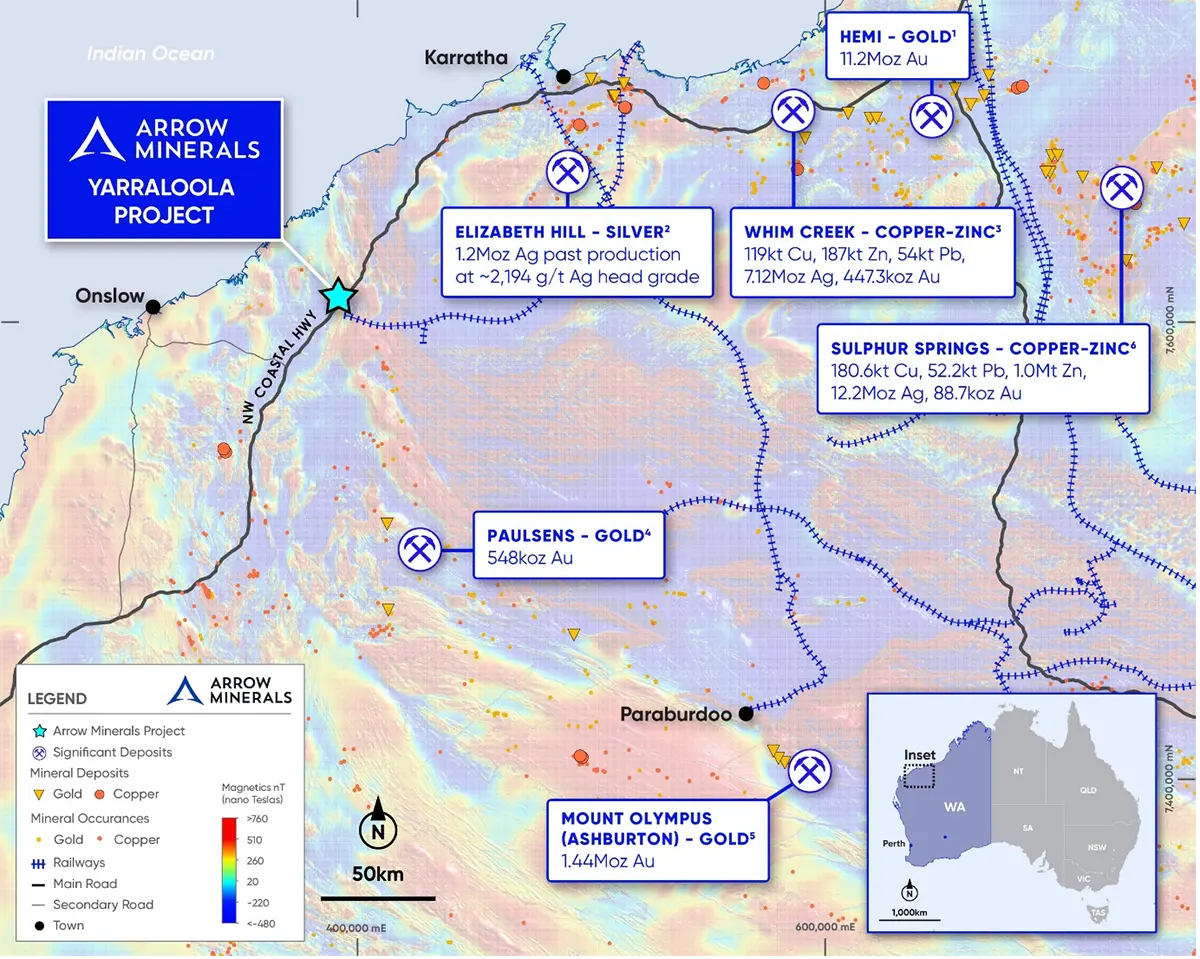
The wider Pilbara region is considered highly prospective for gold and base metals. Noteworthy deposits include Sulphur Springs, Paulsens, Mount Olympus, Whim Creek and Hemi (see map), demonstrating the gold and base metals potential of the Pilbara region.
The Geological Survey of Western Australia (Maitland, 1909) reported that Yarraloola was first discovered in 1907 and was subsequently mined at a small scale for copper in 1963 yielding 2.8t of copper ore and cuprous concentrate at an average grade of 14.6% copper. The prospect is highlighted by a large extensive gossan in the vicinity of the historical mine with copper staining at surface.
While high copper grades were achieved in early surface sampling, limited systematic drilling completed by Great Boulder Mines Ltd (GBML) and WMC further identified the presence of interbedded volcanics and sediments with mineralisation that is anomalous for copper, silver, lead and zinc.
Better intercepts from historical drilling include:
Drill collars, significant intercepts, and full historical assays for all holes retrieved and transcribed to date are provided in Appendix 1 of the ASX Announcement dated 28 April 2026.
WMC and Marston (1979) interpreted the mode of occurrence of mineralisation to be that of a Volcanogenic Massive Sulphide (VMS) system, a style of mineralisation that contributes significantly to global sources of base and precious metals including copper, lead, zinc, silver, and gold.
The Company has discovered that core from 7 diamond drillholes completed at Yarraloola are preserved at the Geological Survey of Western Australia’s Core Library at Carlisle, Perth, WA. Recent inspection of this drill core supports the VMS mineralisation model. The Company is in dialog with GSWA to have non destructive test work completed on the drill core that remains with the objective of developing an early understanding of the alteration assemblage that is associated with mineralised intercepts of the drill core.